There are relatively few studies quantifying the exact efficacy of scrambling over the more traditional random digital shift initialization of Sobol sequences. Consequently, I was pleasantly surprised to discover the paper “The importance of being scrambled: supercharged Quasi Monte Carlo” by J. Hok and S. Kucherenko. However, their analysis presents two notable limitations:
Insufficent Replications: The choice of only 10 replications (n=10) is too small to definitively conclude that scrambling outperforms a basic digital shift. For an underlying normal distribution, the standard error (SE) of the sample standard deviation (s) is roughly estimated by:
$$\text{SE} = \frac{s}{\sqrt{2(n-1)}}$$
Lack of Scale Invariance: Their implementation of Peter Jäckel’s hyperbolic local volatility model violates scale invariance. If both the spot price and strike price are scaled down by a factor of 100, the price of a geometric Asian option should logically scale down by 100 as well. This property does not hold true in their code. I replicated their methodology as faithfully as possible using data from the text; my resulting prices were highly similar (yielding a relative error of roughly 10 bps but did not match perfectly).
To resolve the scaling issue, the correct configuration requires fixing the spot price at 1.0 alongside normalized strikes at 0.8, 1.0, and 1.2.
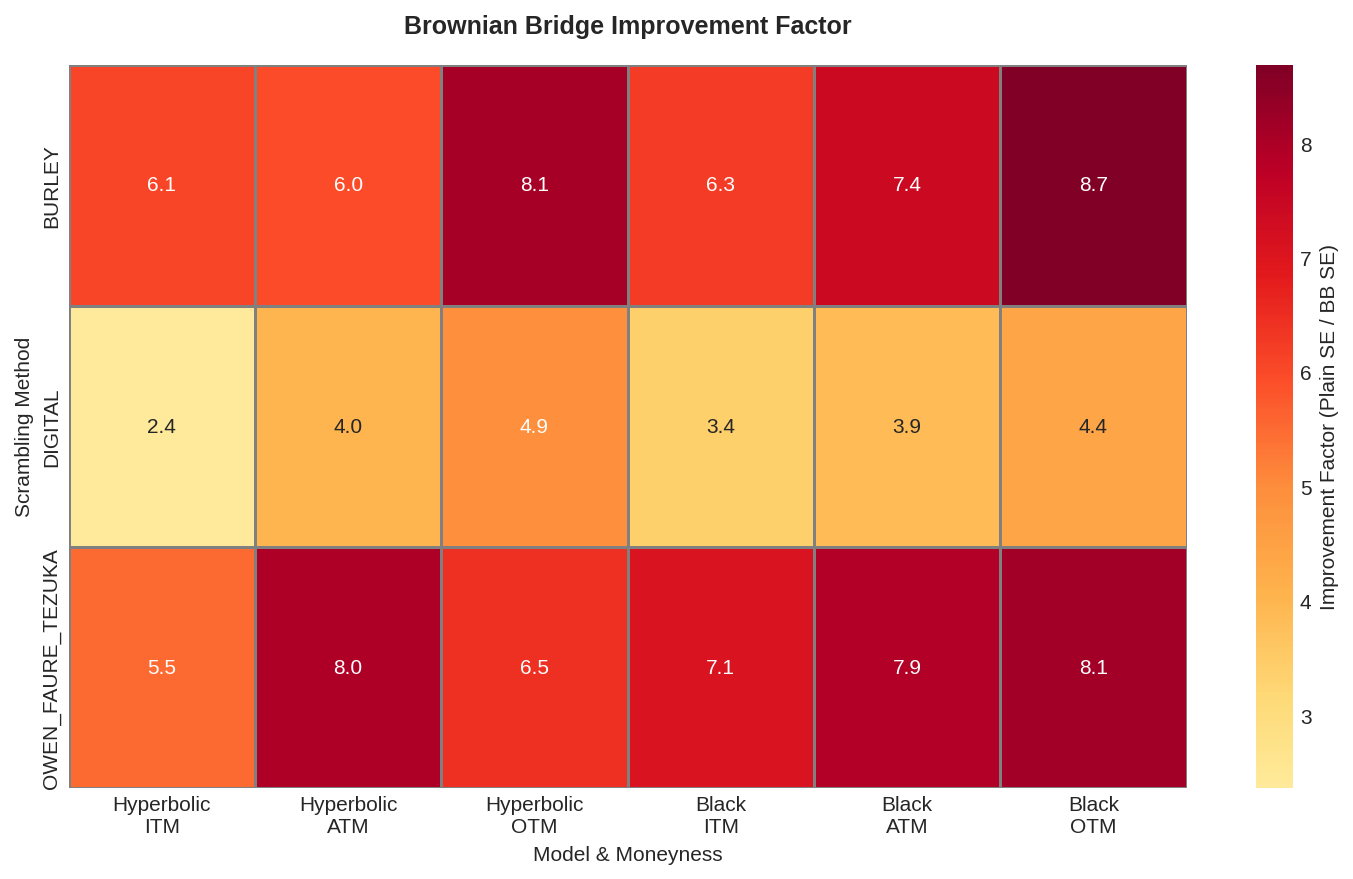
Ultimately, the core conclusions highlighted in the paper remain valid, though incorporating a Brownian Bridge framework (indicated by the _bb suffix below) is absolutely essential. Utilizing 64 scrambling paths with an N = 4,096 * 64 setup, we get the following results:
Ratio of standard error reduction with Brownian Bridge and 64 randomizations compared to the plain construction. Randomization/Scrambling give nearly equivalent standard errors with the plain construction.
ITM Results (K = 0.8)
Method
Strike
Value
RQMC-SE
replicate-SD
BURLEY rqmc_plain
0.8
21.0090
3.006e-03
2.405e-02
BURLEY rqmc_bb
0.8
20.9972
4.939e-04
3.951e-03
OWEN_FAURE_TEZUKA rqmc_plain
0.8
20.9944
3.154e-03
2.523e-02
OWEN_FAURE_TEZUKA rqmc_bb
0.8
20.9983
5.721e-04
4.577e-03
DIGITAL rqmc_plain
0.8
20.9939
3.169e-03
2.535e-02
DIGITAL rqmc_bb
0.8
20.9979
1.342e-03
1.074e-02
PHILOX rqmc_plain
0.8
21.0694
2.788e-02
2.230e-01
ATM Results (K = 1.0)
Method
Strike
Value
RQMC-SE
replicate-SD
BURLEY rqmc_plain
1.0
7.17029
4.563e-03
3.650e-02
BURLEY rqmc_bb
1.0
7.16948
7.646e-04
6.117e-03
OWEN_FAURE_TEZUKA rqmc_plain
1.0
7.17312
4.830e-03
3.864e-02
OWEN_FAURE_TEZUKA rqmc_bb
1.0
7.17117
6.064e-04
4.851e-03
DIGITAL rqmc_plain
1.0
7.16456
4.493e-03
3.595e-02
DIGITAL rqmc_bb
1.0
7.17021
1.124e-03
8.991e-03
PHILOX rqmc_plain
1.0
7.21471
2.029e-02
1.623e-01
OTM Results (K = 1.2)
Method
Strike
Value
RQMC-SE
replicate-SD
BURLEY rqmc_plain
1.2
1.31982
4.803e-03
3.843e-02
BURLEY rqmc_bb
1.2
1.32574
5.942e-04
4.754e-03
OWEN_FAURE_TEZUKA rqmc_plain
1.2
1.32373
4.267e-03
3.414e-02
OWEN_FAURE_TEZUKA rqmc_bb
1.2
1.32612
6.606e-04
5.285e-03
DIGITAL rqmc_plain
1.2
1.33147
4.510e-03
3.608e-02
DIGITAL rqmc_bb
1.2
1.32658
9.143e-04
7.315e-03
PHILOX rqmc_plain
1.2
1.33791
9.055e-03
7.244e-02
Similar behavior holds for a regular Asian and the Black model. Under the Black model with no drift, the improvements also holds for ATM and OTM.
ITM Results (K = 0.8)
Method
Strike
Value
RQMC-SE
replicate-SD
BURLEY rqmc_plain
0.8
0.261331
2.377e-04
1.902e-03
BURLEY rqmc_bb
0.8
0.261440
3.800e-05
3.040e-04
OWEN_FAURE_TEZUKA rqmc_plain
0.8
0.261378
2.462e-04
1.970e-03
OWEN_FAURE_TEZUKA rqmc_bb
0.8
0.261487
3.480e-05
2.784e-04
DIGITAL rqmc_plain
0.8
0.261524
2.225e-04
1.780e-03
DIGITAL rqmc_bb
0.8
0.261458
6.548e-05
5.238e-04
PHILOX rqmc_plain
0.8
0.263262
9.820e-04
7.856e-03
ATM Results (K = 1.0)
Method
Strike
Value
RQMC-SE
replicate-SD
BURLEY rqmc_plain
1.0
0.180786
2.876e-04
2.301e-03
BURLEY rqmc_bb
1.0
0.180913
3.896e-05
3.117e-04
OWEN_FAURE_TEZUKA rqmc_plain
1.0
0.180743
2.784e-04
2.227e-03
OWEN_FAURE_TEZUKA rqmc_bb
1.0
0.180931
3.514e-05
2.811e-04
DIGITAL rqmc_plain
1.0
0.181196
2.686e-04
2.149e-03
DIGITAL rqmc_bb
1.0
0.180915
6.917e-05
5.533e-04
PHILOX rqmc_plain
1.0
0.182375
8.876e-04
7.100e-03
OTM Results (K = 1.2)
Method
Strike
Value
RQMC-SE
replicate-SD
BURLEY rqmc_plain
1.2
0.125452
3.352e-04
2.682e-03
BURLEY rqmc_bb
1.2
0.125638
3.857e-05
3.085e-04
OWEN_FAURE_TEZUKA rqmc_plain
1.2
0.125484
2.962e-04
2.369e-03
OWEN_FAURE_TEZUKA rqmc_bb
1.2
0.125641
3.642e-05
2.913e-04
DIGITAL rqmc_plain
1.2
0.126028
3.105e-04
2.484e-03
DIGITAL rqmc_bb
1.2
0.125622
7.113e-05
5.690e-04
PHILOX rqmc_plain
1.2
0.126773
7.702e-04
6.161e-03
I also realized that the digital shift can be implemented by just setting the first point (0,0,0,…,0) to a random point before applying the classic greycode Sobol construction, which is much simpler than any other randomization technique.